Redesign Hiroshi Ramen Menu
A visual redesign of Hiroshi Ramen's menu to improve readability, hierarchy, and overall brand feel.
Original Menu Design
Design goals
Yesterday, I went to a famous ramen place in San Francisco for the first time. While the food was amazing, I found the menu quite overwhelming and hard to navigate. It was quite surprising to me that a Japanese restaurant would have such a cluttered menu design because Japanese people are famous for their meticulous attention to detail and aesthetics. As a result, I decided to practice my design skills by improving the menu's layout, visual hierarchy, and readability.
Process
As a customer, what I care most about whenever I go to a restaurant and scan their menu include: the ingredients and the price. Therefore, my critiques below will focus on how well the original menu design supports me in finding these information quickly and easily.
Design Critique
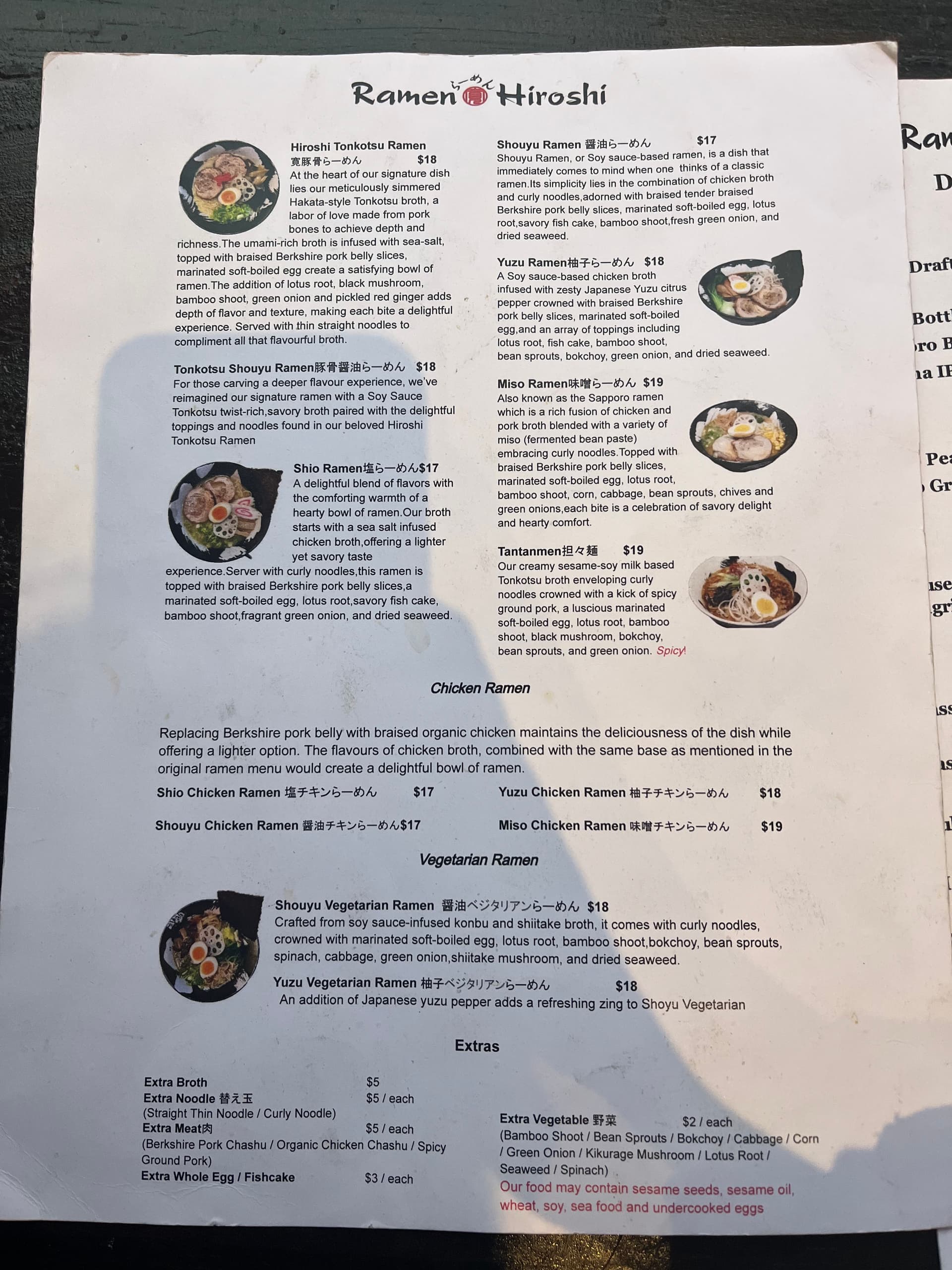
First, the original design has no visual hierarchy because it uses the same font size for all elements: dish title, price and descripstion.
Second, the description of the dish is too lengthy and small. This creates cognitive overload because there is too much information I need to process in order to choose a dish.
Third, there is a lack of consistency. Some dishes have pictures associated with them while some don't
Finally, the layout of the menu is very cluttered and does not support me in finding the information I want using eye-scanning patterns such as Z or F.
Design Decisions
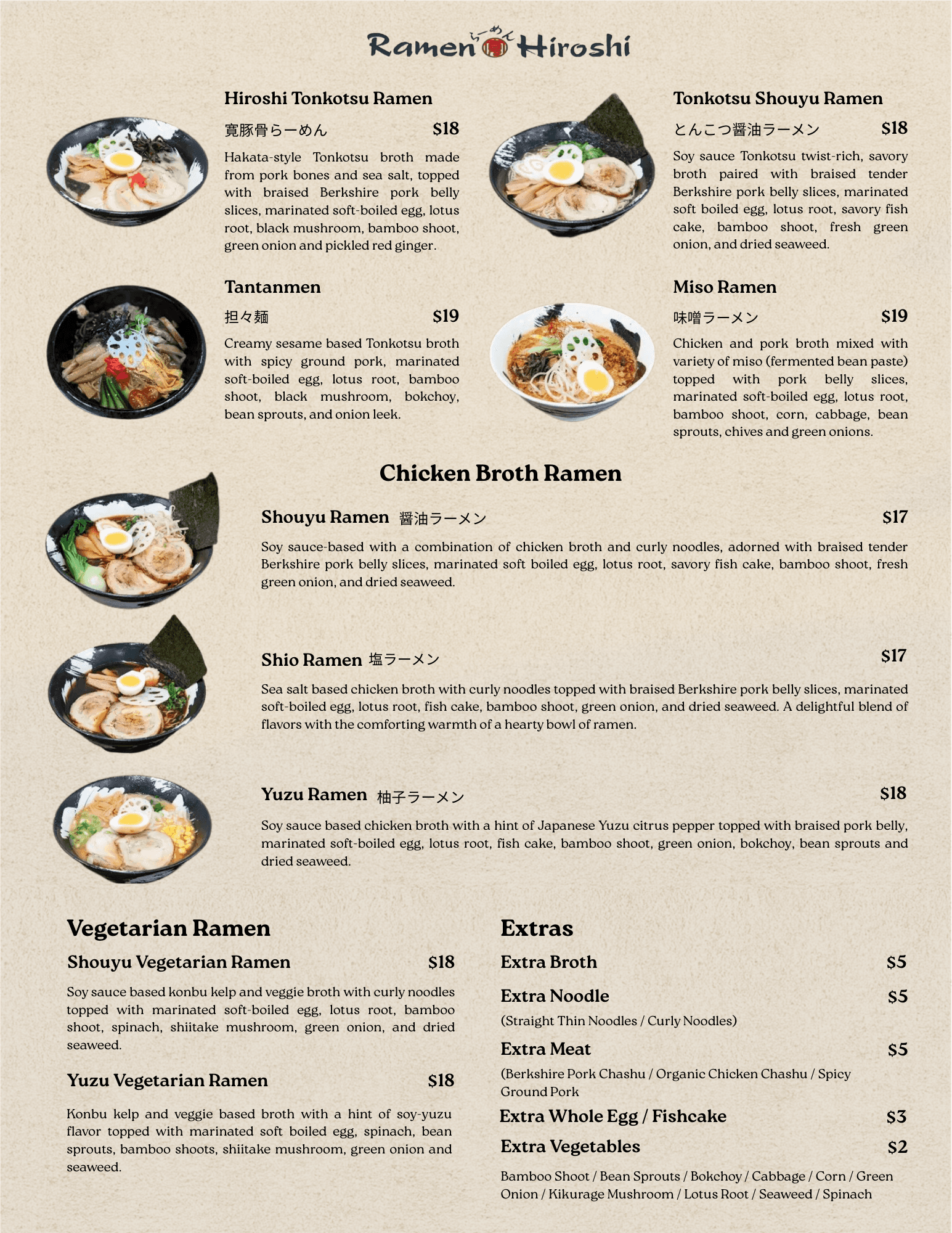
Visual Hierarchy: I established a clear visual hierarchy where the title of the dish and its price have a bigger font size (11.5 px) with greater weight (bold) compared to the description of the ingredients (8.5px and light).
Cognitive Load: I shortened the description by removing all the adjective expression about the dish and keeping only the nouns that represent the ingredients. I also ordered the options based on the prices so that customers can quickly scan which option is the cheapeast and which one is the most expensive.
Consistency: I ensured consistency by adding an image for each dish, except for the vegetarian options because they represent the same dishes just with different ingredients.
Layout: I made two decisions regarding the layout choices based on the number of dishes of each category: 1) for the pork-based ramen broth, because there are 4 dishes, I decided to use a two-column layout to save space and create balance, 2) for the chicken-based options, because there are only 4 dishes, I used a single-column layout to avoid creating an empty space, and 3) for the vegetarian and extras sections, I used a single-column layout to create a sense of simplicity.